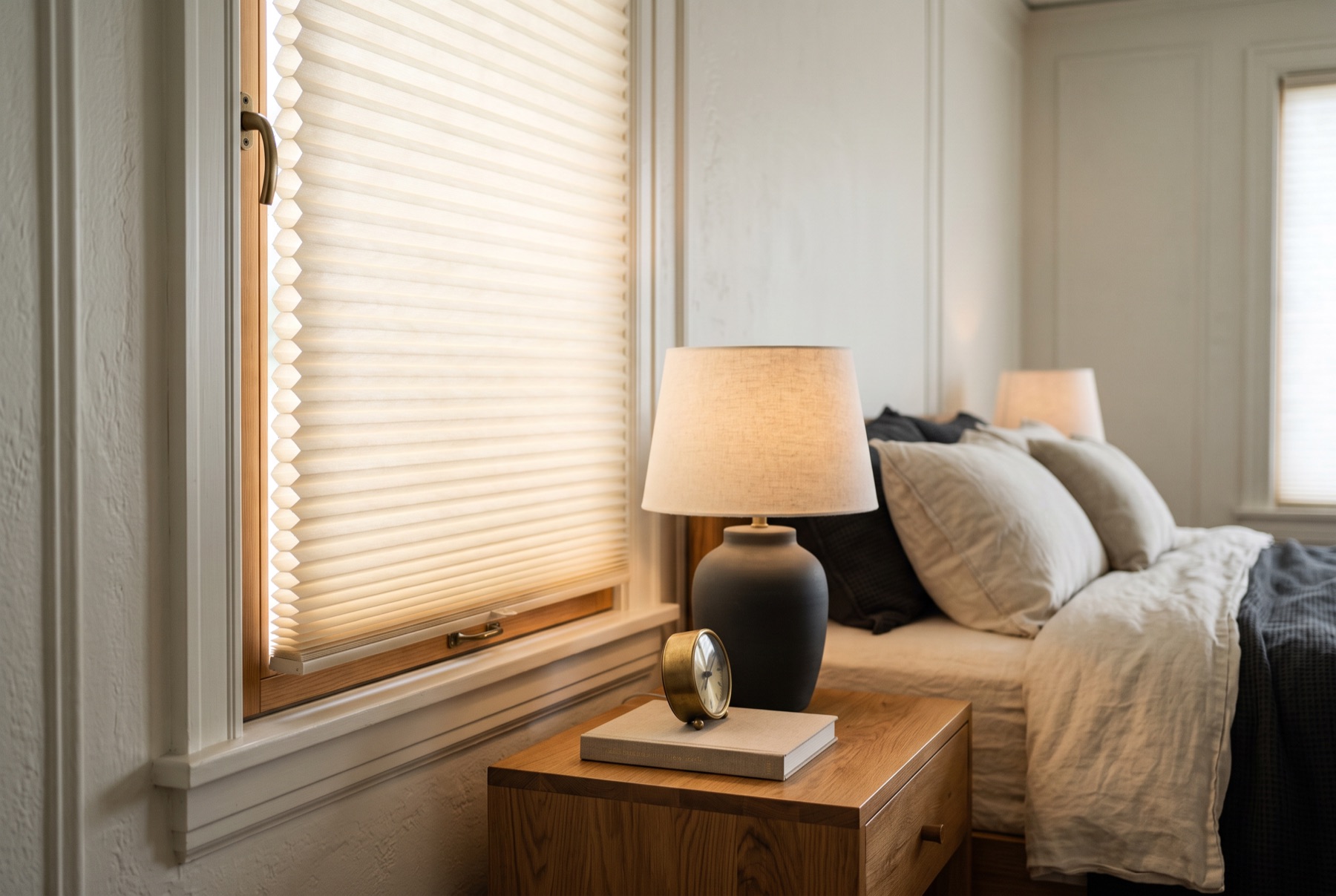
Winter on Bainbridge is not the kind of cold that makes the news. It is the kind that settles in around the end of October and does not really leave until April. Grey, damp, and long. The heating bill creeps up and you are not sure exactly when it happened.
Almost every time we get called about a cold room on this island, the windows are the reason.
Where the heat actually goes
A wall in a reasonably built house insulates several times better than the glass sitting in it. That is true even with good windows. So in a room with a big west-facing view, which is most of the rooms people love most around here, the glass is the weak point by a wide margin.
You can feel it. Stand by the window on a January evening and there is a cool draft running down toward the floor. That is not air leaking in. That is room air touching cold glass, dropping, and pulling warm air across the ceiling to replace it. The room never settles.
Why honeycomb shades do something about it
A honeycomb shade is built as a row of pleated cells, and each cell holds a pocket of still air. Still air is the insulator. It is the same reason a down jacket works, and the same reason a double pane window beats a single pane.
Single cell is the standard. Double cell adds a second row of pockets and insulates better, at the cost of a slightly thicker stack when the shade is raised. On a big window that stack matters. On a bedroom window it usually does not.
Hunter Douglas calls their version Duette, and it is the product we fit more of than anything else on the island, for exactly this reason.
What it looks like in a real island house
Two situations come up constantly.
The first is a waterfront house with a wall of glass facing the water. Beautiful, and in winter the whole room runs cold. Cellular shades on the lower half, left open during the day for the view, closed at dusk, make a noticeable difference by the second evening.
The second is an older Winslow house with original windows that nobody wants to replace, and for good reason. Replacing windows on a house like that is expensive and it changes the character. Shades are reversible, they cost a fraction, and they get you most of the comfort.
Two things people do not expect
The first is quiet. Cells that trap air also absorb sound. Rooms facing a road or the ferry line get noticeably calmer. Nobody buys cellular shades for this and everybody mentions it afterwards.
The second is condensation, and this is the honest part. If you insulate a window well, the glass runs colder, because less room heat is reaching it. On a damp island night that can mean more moisture on the pane, not less. It is not a fault in the shade, it is physics doing what it does.
The fix is simple. Leave a small gap at the bottom, or raise the shades for a while in the morning, and wipe the sills through the worst of the winter. If a room already has a condensation problem, tell us during the consultation and we will plan around it rather than hand you a surprise in December.
What we would actually suggest
A few things worth deciding up front, because they are hard to change later.
- Top down, bottom up. The shade opens from either end. You get daylight across the top of the window and privacy at eye level at the same time. On a street-facing room it is the difference between using the room and keeping the shades shut.
- Cordless. No cords at all. Safer with small children and dogs, and it looks cleaner.
- Motorization for anything high. If a window is above a stairwell or over a kitchen sink, a shade you cannot comfortably reach is a shade that never moves, and a shade that never moves is not saving you anything. Motorized shades solve it, and they can run on a schedule so the house closes itself up at dusk.
Is it worth it
We are not going to put a number on your heating bill. It depends on the house, the glass, how you heat and how you live, and anyone who quotes you a percentage is guessing.
What we will say is that comfort shows up immediately and it is the thing people actually notice. Rooms hold their temperature. The cold edge near the window goes away. You stop avoiding the chair by the view in January.
If you want to see the difference between single and double cell with your own hands, they are both on the wall at the showroom, and we are happy to talk through your specific windows. Consultations are free, we measure everything ourselves, and there is no pressure to decide on the spot.