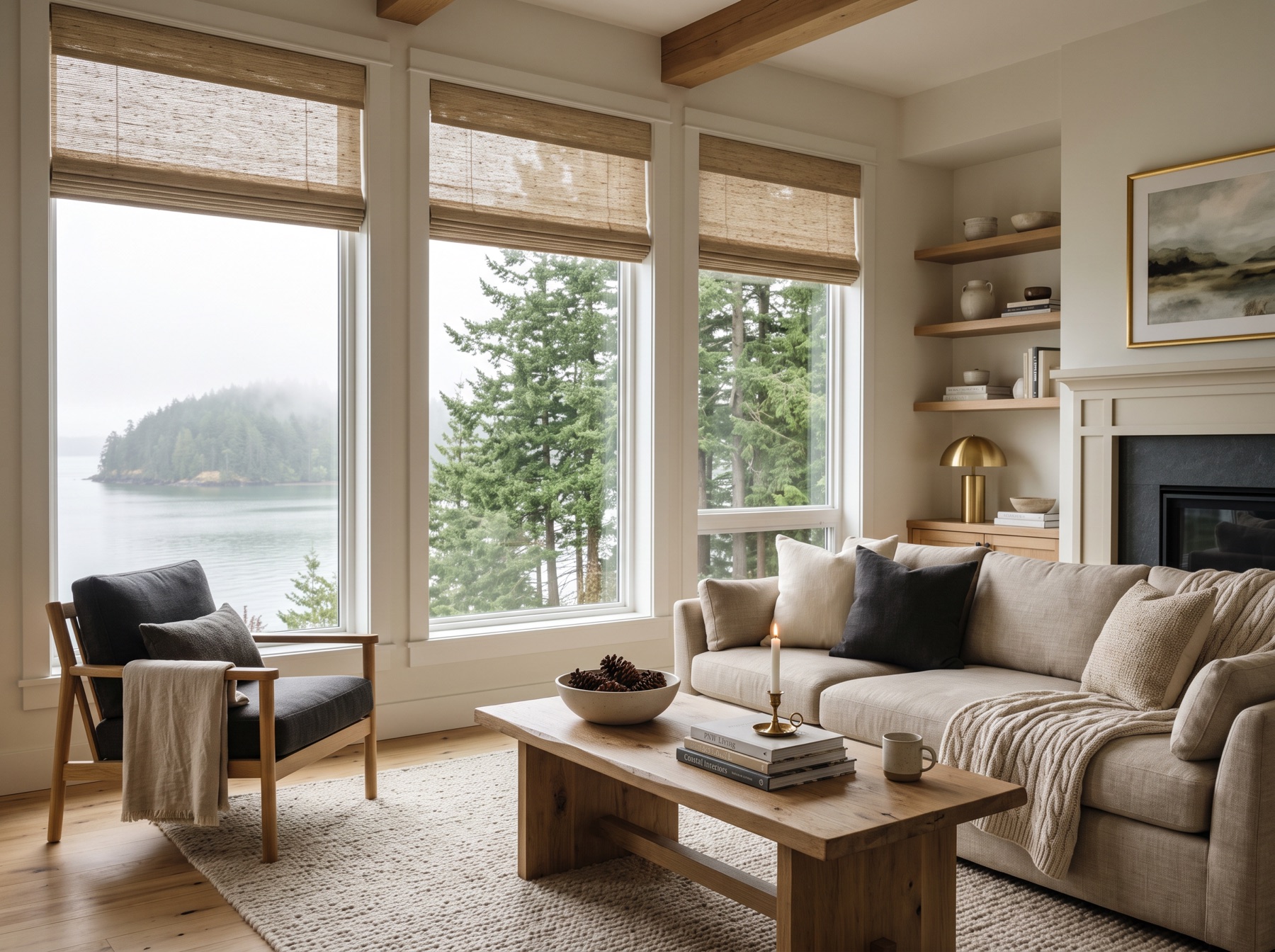
People walk into the showroom and ask for blinds when they mean shades about half the time, and it does not matter at all. But the difference is real, and once you see it the choice for each room gets a lot easier.
The actual difference
Blinds have slats. Hard horizontal or vertical pieces that tilt. You can close them, open them flat, or angle them to let light in at the ceiling while keeping it out of your eyes.
Shades are a continuous piece of fabric. They go up and down. There is no tilting, because there is nothing to tilt.
That is it. Everything else follows from it.
When blinds win
When you want to steer the light rather than just reduce it. A tilted slat throws daylight up onto the ceiling, which fills a room with soft light and keeps the glare off a screen or a kitchen counter. Fabric cannot do that. It is either up or down.
When the view matters at some times of day and not others. Tilt for privacy in the evening, open flat in the morning, without losing the window entirely.
When the room wants some structure. A wood blind has a horizontal rhythm that suits a study, an older house with trim worth matching, or a room that otherwise reads soft.
When it needs washing. Slats wipe. This is why blinds end up in kitchens and bathrooms.
When shades win
When you want the window to disappear. A roller shade rolls up into almost nothing. For a wall of glass facing the water, that is usually the whole point. Slats always leave a stack.
When you are trying to keep heat in. A honeycomb shade traps air in its cells and insulates. Blinds have gaps between every slat by design, so they do very little here. On this island, over a long grey winter, that difference is worth real money.
When you want softness. A roman shade folds like drapery. In a bedroom or a sitting room, fabric warms a space in a way a hard slat does not.
When you need genuine blackout. Light leaks between slats no matter how well a blind is made. If somebody sleeps days, or a room has a projector, a shade is the honest answer.
The ones that are both
A few products sit in the middle and they are worth knowing about, because they often solve the argument.
Silhouette shades are fabric vanes floating between two sheer layers. They tilt like a blind and soften like a shade, and they turn hard afternoon light into something diffuse. On a west-facing island room they are hard to beat.
Banded shades alternate sheer and solid stripes on a single roller. Line them up one way for a clear view, shift them for privacy. They look modern and they are simple to live with.
Specialty shapes
Arches, angles, trapezoids over a stairwell, the tall triangle at the end of a vaulted room. A lot of houses here have at least one, usually facing the water, usually the window nobody has ever covered because it seemed impossible.
It is not impossible. Architectural shades are built to the shape. Some are fixed, which is right when the window is purely for light and view. Some operate, which matters when it is throwing heat into the room every afternoon.
The only real rule is that these have to be measured properly. An arch is not a rectangle with a curve drawn on it, and a guess will cost you the whole unit, because it is made to order and it will not fit anything else. This is the single strongest argument for having someone measure who is going to be responsible for the result.
Mixing them in one house
You do not have to pick one. Most houses we do are a mix, and the ones that look best follow one simple discipline.
Keep it consistent per elevation, not per room. Anything visible from the street or the water should read as one decision. Inside, let each room do what it needs. A kitchen in alternative wood and a bedroom in honeycomb is fine. A living room with three different products on three walls is not.
Colour does more work than product type here. Holding a close colour across the house lets you change material room by room without it looking accidental.
A shortcut
If you want one question to ask yourself per room, it is this. Do I want to control the light, or the temperature and the privacy?
Control the light, and you probably want blinds. Control the temperature and privacy, and you probably want shades. Want both at once, and that is what Silhouette and banded shades exist for.
Everything in this post is working on the wall at the showroom, which is genuinely the fastest way to settle it. Ten minutes with the real thing beats an afternoon of photographs. Or book a free consultation and we will bring samples to the house and look at your actual light.